

 English
 French
 German
 Italian
 Portuguese
 Russian
 Spanish
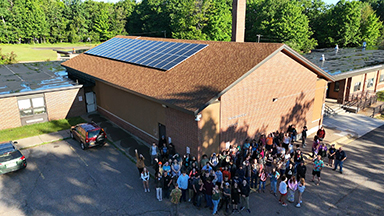 MARQUETTE, MICH. —With the 2025-26 academic year winding down in early June, schools across the Upper Peninsula have put a bow on the school year. In the Central UP, a hands-on alternative school partnered with two tribal nations to make it a year to remember.
At Marquette Alternative High School, the future is brighter than ever, in part thanks to the installation of a new rooftop solar array that helps power the building and teach pupils about the power of sustainable energy.
In September 2025, four years of working and planning concluded with the installation of an 18.1-kilowatt solar panel system that aims to power roughly one-third of the school’s energy needs. The goal of the project was creating a clean power source, and just as importantly, teaching youth about the benefits of sustainable energy.
Leading the charge to bring a solar panel array to the alternative high school was teacher Brian Prill.
“We want to make our school and community a better place,” said Prill, noting the idea was sparked by students in an economics class he taught that focused on the United Nation’s Sustainable Development Goals. “The students decided as a group to see if solar energy was feasible.”
The 18.1KW system cost just over $69,000 and was installed over a four-year period. Due to a substantial investment, “the Alt” turned to community partners with carbon neutral ambitions to make the dream a reality.
A collaboration between the Sault Ste. Marie Tribe of Chippewa Indians and Keweenaw Bay Indian Community was able to assist in funding that allowed the school to apply for a state grant, which fully funded the project. Over several years of applying for funds, approximately $35,000 came from the two tribes’ 2% funds that are designed to invest in communities they serve. These funds were essential in securing a state-matching grant to cover the cost of the project.
“It was a big project, and we were asking what they can support,” added Prill, citing the importance of the relationships between tribal governments and local education. “It’s about friendship amongst all government and reducing our carbon footprint.”
Prill said students are still assessing how much energy has been saved during the school year and have dashboards in the classroom to assess energy savings and consumptions. Students will review the data after a year with goals of using money saved to apply for more grants to grow the solar panel array.
“Energy sovereignty is highly valued within the Sault Tribe, making this project especially impactful to tribal membership in the Marquette area and the Central UP as a whole,” said Sault Tribe Chairman Austin Lowes. “Teaching the values of sustainability to students will have long term impacts across the UP.”
In Marquette, there are over 1,200 Sault Tribe members. Marquette Alternative High School has a sizeable tribal representation amongst its student body. The success of the Marquette Alternative High School’s solar panel array shines a bright light on collaboration between tribal nations and local education systems.